If your foursome plays a dollar closest-to-pin on the par 3s, you're playing a side game. If someone in the group says "five bucks for longest drive on 15," that's a side game too. If the losing team on the front nine says "double or nothing on the back," you're one step away from Nassau.
You've been playing side games all along. You just call them "that thing we do." Here's the reframe: the difference between what your group is doing and Skins isn't complexity — it's just formality. Once you notice, upgrading is easy and the rounds become even more fun.
The stealth side games you're already playing
Look at what actually happens on a casual round with money in the group. Some or all of these are running the whole time, whether anyone's tracking them or not.
- Closest-to-pin. A dollar per player on any tee shot that finishes closest to the flag on a par 3. Every group does this. It's a side game.
- Longest drive. Same energy, different hole — usually declared on a specific par 5.
- Greenies. Bonus for hitting the green in regulation on a par 3, or getting closest to the pin. Optional, but very common.
- Sandies. Up-and-down from a bunker for par. Nobody plans to play sandies, but somebody always calls one at the ninth after saving par from the trap.
- Snake / trash. Whoever three-putts gets the snake. Whoever's holding it after 18 pays. It's a side game.
- One-hole skins. "Five bucks on 18?" That's a skins game with a single-hole pot.
- Presses. "Double or nothing on the back nine." That's a Nassau press. You just didn't call it Nassau.
Why nobody in your group calls these side games
Ask anyone in a casual foursome if they play side games and half will say no. Then they'll open their Venmo after the round…
The disconnect is what people think a side game is. When most casual golfers hear "side game," they picture Wolf — rotating partners, Blind Wolf, Lone Wolf multipliers, some guy at the bar explaining the rules for the fourth time. That level of format complexity is where their brain goes, and they decide it's not for them.
But side games are just structured versions of the informal bets your group is already making. The mental math you're doing on the fly for closest-to-pin — same math, one hole, one payout — is the same math a full skins game asks of you, just spread across 18 holes.
The upgrade path is smaller than you think
If your group is already tracking closest-to-pin on the four par 3s, adding Skins takes zero cognitive load. You're already comparing scores hole-by-hole in your head to figure out who won the pin. Just formalize it across all 18 holes and you have skins.
If your group already does "double or nothing on the back nine," you're a Nassau player. Nassau is literally three bets: front, back, and total, with presses when you fall behind. What you're already doing is the same structure — you just haven't split the front nine off yet.
The real barrier to a more formal side game isn't complexity. It's tracking. Wolf isn't hard to play; it's hard to track on a scorecard while you're also trying to golf. Vegas isn't hard to play; the two-digit pairing math is what most groups skip. ForeBoard handles the tracking automatically so your group can play any format without a spreadsheet. Score the hole, the app does the rest.
How to graduate your group
If you want to upgrade from informal bets to a structured side game, pick one new format per round. Not three. One.
- Start with skins. It's the closest to what most casual groups already do — lowest score on the hole wins, ties carry over. If you're already doing closest-to-pin, this is a lateral step.
- If your group is competitive and vocal, try Wolf next round. Rotating partners feels more social than skins and takes little to explain — one guy picks a partner off each tee.
- If your group is mostly the same skill level, Vegas is the natural upgrade. It rewards consistency, punishes blow-up holes, and keeps every player in every hole.
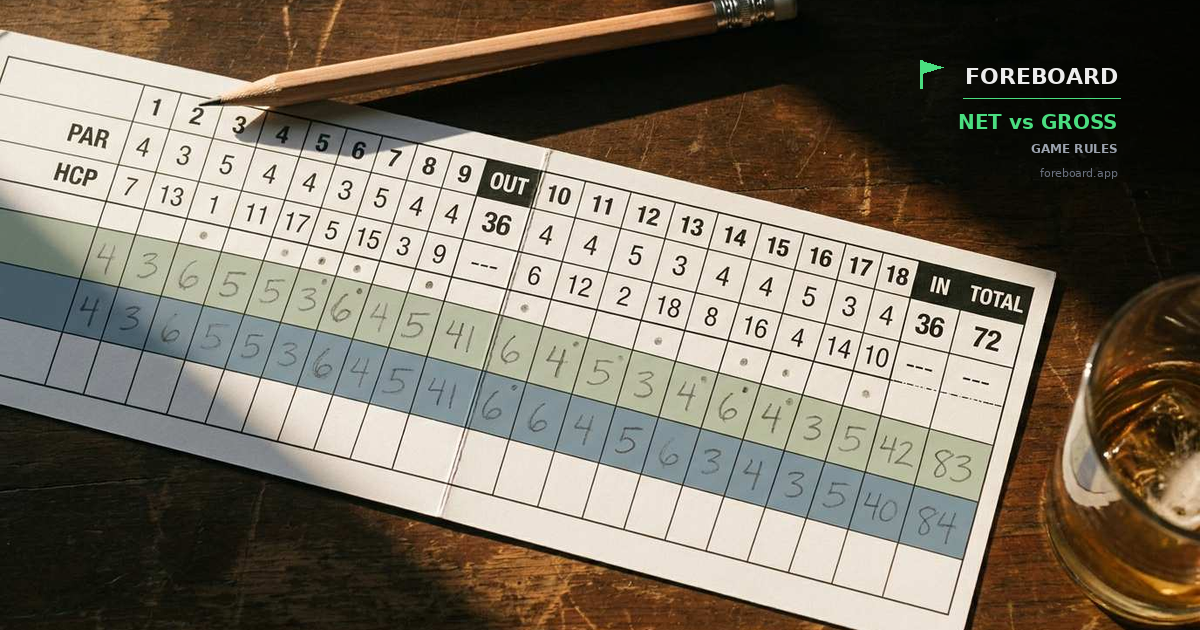
- If your group is mixed handicaps, add net scoring to whatever format you pick. It's what lets the 22-handicap actually compete against the 6.
Don't try to change everything at once. One new format per outing, keep the informal bets you already like, drop what doesn't stick.
The point isn't to complicate golf
Side games make the round more engaged, not more complicated. If they're not fun for your group, drop them. But if you've ever bet a dollar on the 8th tee to see who lags closest to the pin, you already know they work. You're just playing at the base level.
The step from "that thing we do" to "we play skins" is smaller than it seems.
Want to try a structured side game without the tracking? Set up a round on ForeBoard → Pick your format, share the link in the group chat, and the math handles itself. No app, no account, no scorecard arguments at the bar.