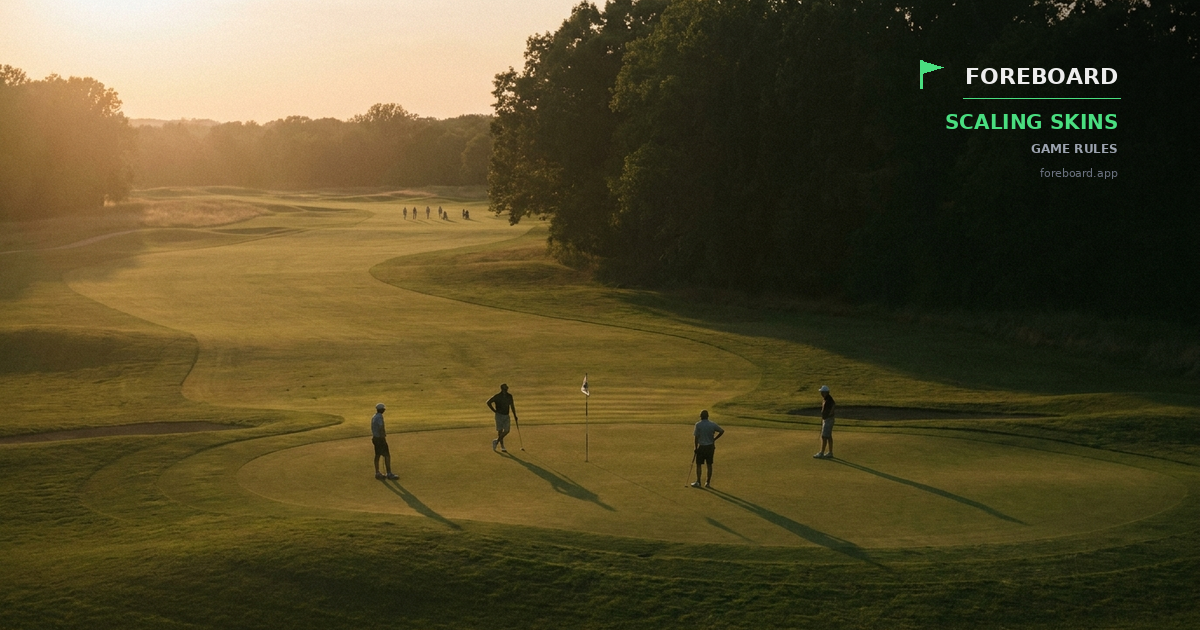
Skins is the easiest casual game in golf to start. Lowest score on a hole wins a "skin," ties carry over and the pot grows. The game almost runs itself.
It's also especially challenging to scale. The moment you have five or more players spread across multiple tee times, the math falls apart and the social moment dies. Here's how skins actually works at each size — and where the wheels come off.
The four-player baseline
With four players in one group, skins is barely a game in the operational sense. Everyone tees off together, everyone watches every shot, and the running tally happens at the cart between holes. Someone shoots a 3; you all do the mental check — anyone else tie a 3? No? They've got the skin (or it's still riding from a previous tie). Easy.
The pot is visible, the math is mental, and the smack talk on the next tee box is what you came for. If you're consistently playing skins with three or four guys, you probably don't need an app, especially with gross scoring. A pencil and a 10-second conversation between holes largely handles it.
Full Skins rules and strategy →
The 5+ player problem
Now you're eight players across two tee times — Group A and Group B, going off the first tee 12 minutes apart. Or worse: 16 players across four groups. The math problem multiplies.
Group A finishes hole 7 with someone shooting a clean birdie. They high-five, congratulate the winner, mark it down — "Joe takes the skin on 7." Except… Group B is still on hole 3. Joe doesn't actually have the skin on 7 yet. The skin on 7 isn't decided until Group B (and any other groups) plays hole 7 too.
You have a couple options:
- Yell across the fairway to ask what the group's best score was on hole 7 to learn where the skins stand. Repeat this whenever possible throughout the round to better understand what the skins tally looks like.
- Wait until everyone is back in the clubhouse and do the math there.
Why net scoring makes it worse
Then add handicaps. Skins with net scoring is the most popular format in casual groups because it actually lets the higher handicaps compete — but it also introduces a layer of math that breaks across groups.
Every player gets strokes on specific holes based on the hole's handicap index (1–18 difficulty ranking). A 9-handicap gets a stroke on the nine hardest-rated holes; a 16-handicap gets one on sixteen of them; a 4-handicap only gets strokes on the four hardest. Their "net" score on hole 7 depends on whether hole 7 is one of their stroke holes — and they're not all comparing the same gross-to-net delta.
In a single group, you can squint at the scorecard and figure it out. Across two groups playing different holes at different times, "did I win this skin?" stops being answerable until someone sits down at the bar with all four scorecards.
What live scoring fixes
When every group enters scores in real time on the same platform, the cross-group comparison happens automatically.
ForeBoard runs the skins math across all groups, applies each player's handicap allocation per hole, and tells you when skins are settled and when they carryover. Group A enters their hole 7 birdie — the app marks it as a provisional skin until Group B plays hole 7. When Group B's scores come in, the app finalizes the skin (or carries it over) and updates everyone's running pot. No spreadsheets, no waiting until after the round, no scorecard arguments at the bar.
The other benefit: seeing what other groups are doing
Live cross-group scoring isn't just about getting the math right. It changes the social experience of the round.
In a paper-scored multi-group skins game, Group A has no idea what Group B is doing. They're playing their own round and guessing at the standings until everyone meets in the clubhouse. The big moments — a chip-in on 14, a birdie on a par 5 that you're sure took the skin — happen in isolation. Group B doesn't hear about it until you tell them. You don't hear about Group B's eagle until they tell you.
Live scoring puts every group in the same conversation. Group A on hole 12 can see what Group B just did on hole 11. Group B teeing off on hole 6 can see Group A's score on hole 6 already locked in. The leaderboard becomes shared narrative and adds a competitive layer to the round while on the course.
The social moment isn't lost when you scale skins. It's amplified.
When this actually matters
If you're three guys at a public course on a Saturday playing $1 skins, you don't need any of this. Pencil works.
The moment you cross into multi-group territory — a buddies trip with eight players, a weekly league with 12, a corporate outing running skins across the field, any group above four — the operational lift goes from manageable to impossible.
Above four players across multiple tee times, an app stops being optional. The math problem is unsolvable in real time without one, and the social game suffers from the information gap. Below four, it's a luxury.
Running skins with a bigger group this weekend? Set up your round on ForeBoard → Pick the format, share the link with every group, and the skins math handles itself across as many tee times as you need. No app to download, no account, no scorecard arguments at the bar.