When someone tells you they shot a 92, they almost always mean gross — every stroke counted. When someone tells you they won the net flight, they're talking about a different math entirely. Net vs gross is the most consequential terminology gap in casual golf. It decides who wins money, and who complains the winner was a sandbagger.
Gross scoring
The simple one. Every stroke counts. Your score on a hole is how many strokes it took to hole out. Your round total is the sum of those 18 numbers. No handicap math, no per-hole adjustments, no asterisks.
The pros play gross. Tournament leaderboards usually display gross. Stroke play defaults to gross. If you're tracking your real game over time, gross is the most honest number — your handicap is calculated from it, not the other way around.
The catch: gross is unforgiving when your group has mixed skill levels. A scratch player and a 22-handicap playing gross-only skins isn't a game; it's a transfer of cash from one direction.
Net scoring
Net is gross minus your handicap strokes for that hole. A 14-handicap gets one stroke applied to each of the 14 hardest holes on the course. A 2-handicap gets one stroke applied to the two hardest holes. On those stroke holes (or "pop" holes), their net score is one less than their gross.
Example: you're a 14-handicap, you make a 5 on a par-4 that's rated as the 7th-hardest hole on the course. Because you're getting strokes on holes 1–14, hole 7 qualifies — your net score on that hole is a 4.
Net scoring is the great equalizer. It's what lets a 22-handicap fairly compete against a scratch player in the same skins game. Most casual side games — skins, Nassau, Wolf, league play — are played with net scoring.
The handicap-index trap
Some casual golfers don't realize handicap allocations vary by hole.
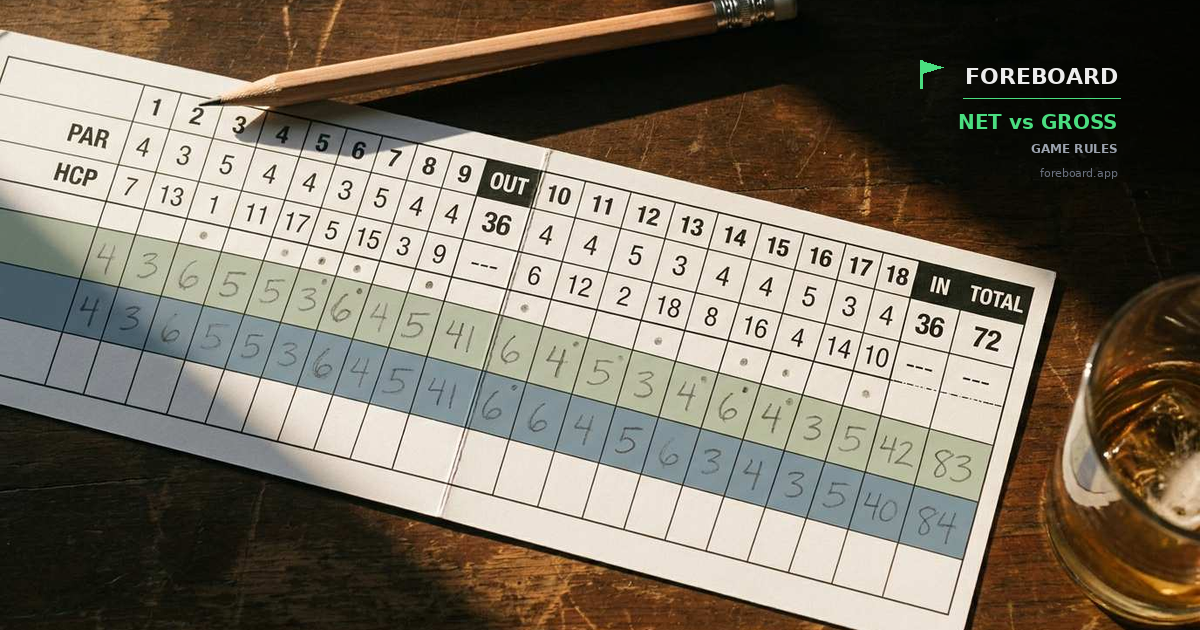
The scorecard has a row labeled Handicap or HCP. It ranks the 18 holes from 1 (hardest) to 18 (easiest), based on how the course rates difficulty. A 14-handicap doesn't get strokes on their worst 14 holes — they get strokes on the course's officially hardest 14 holes, whether they happened to play those well or not.
This trips people up constantly. You can pull a great score out of a hole that's rated easy and not get a stroke for it. You can blow up on a hole that's rated hard and burn the stroke anyway. The handicap row on the scorecard tells you who gets strokes where, and it's the same for every player — only the number of strokes you receive depends on your handicap.
Where this gets confusing in real life
The classic argument at the 19th hole: "I shot a 5, you shot a 4 — you won the hole, right?" Sometimes yes (gross), sometimes no.
If you got a stroke on that hole and I didn't, your net 4 ties my net 4. If we both got a stroke, your net 3 still beats my net 4. If neither of us got a stroke, the gross result stands. Three different outcomes depending on the handicap row no one was looking at.
Multiply by 18 holes and four players, and you've got 72 stroke calculations to track per round. In a single group with one scorekeeper, it's manageable but error-prone. Across two groups, it becomes the forensic exercise that ends most multi-group skins games.
The math problem
Net scoring's whole purpose is fairness across skill levels — but the math required to apply it correctly is real. Most casual groups handle it in one of three ways: skip net scoring entirely and play gross even when it tilts the game, play it badly and end up arguing at the bar, or use a scoring app.
ForeBoard handles handicap allocation per hole, per player, per format — automatically. Enter the gross hole score, and the app applies each player's stroke holes, computes the net score, and displays gross and net leaderboards side by side. The argument at the turn goes away because the math was correct the first time.
The net decision
If you know you are going to use net scoring, you still have a decision to make. Everyone can either play to their true handicap, or everyone can base their handicap off the lowest handicap in the group.
In the first example, if the group has a 5, 8, 11, and 16 handicap, the players pop on the hardest five, eight, 11, and 16 holes.
In the second example, everyone plays off the 5 handicap. So that player would effectively be a 0, the second player would be a 3 (eight minus five), the third player would be a 6, and the fourth player would be an 11.
The second approach can reduce the amount of math required, especially if keeping score by hand without the help of an app.
It generally works for smaller groups playing a single round. If it's a larger group (two or more foursomes), or a multi-round event, it's usually simpler for everyone to play to their own handicap.
When to use which
A quick decision tree:
- Same-skill group (four buddies who all play to a ~12 handicap): gross is fine. Net is unnecessary math.
- Mixed-skill cash game (a 4 and a 22 in the same skins game): net, every time, or the high handicap is just paying for entertainment.
- Tracking your real game (handicap improvement, personal records): gross.
- Tournament with prizes: ideally a net flight and a gross flight, run side by side.
- Casual round with no money (just keeping score): gross unless someone in the group cares about fairness or the group wants to maximize competition.
- Buddies trip where one guy plays scratch and the rest are 15+: net for sure, unless you want the scratch guy to win every game.
The shortest version: if the skill spread in your group is greater than a few strokes, play net. If it's tighter than that, gross works fine.
Want to play net without doing the math? Set up a round on ForeBoard → Pick your format, enter handicaps once, and the per-hole stroke allocation handles itself for the rest of the round. Gross and net leaderboards both displayed live. No app to download, no spreadsheet at the bar.