Nassau is the oldest of the popular wagering games. Played at every level of golf — country clubs, public courses, buddies trips, weekend foursomes — and credited (probably apocryphally) to Nassau Country Club on Long Island in the early 1900s. The reason it's lasted: the match never dies.
In stroke play, a five-shot deficit typically means the round is presumed over (especially if your swing looks like mine). In Nassau, a five-shot hole is hardly a death sentence due to the number of matches that are played, each with their own unique outcomes — the front nine match, back nine match, and overall 18 match. Then there is the press to potentially make up even more ground.
There's no single official Nassau — different groups handle the press limits, the carry overs, and the Vegas press differently. What follows is the base game, plus every variation ForeBoard supports.
The basics
Nassau is three match-play contests running in the same round.
- Front 9 match — holes 1 through 9
- Back 9 match — holes 10 through 18
- Overall 18 match — cumulative across the full 18 holes
You can win the front, lose the back, and tie the overall in the same round — they're independent. The only difference between these matches is when they start and end. This structure is what makes Nassau more forgiving than pure stroke play, but also more dangerous.
Nassau is typically played as traditional match play. Win the hole, you go 1-up on that match. A tied hole is a push. Standard match-play vocabulary applies — 2-up thru 7, all square (AS), dormie 2 (leader up by exactly the number of holes remaining), 3 & 2 (match closed with the leader 3-up and 2 to play).
Stakes are typically structured one of two ways:
- Even (e.g. $5/$5/$5, $10/$10/$10, $20/$20/$20). Each match is worth the same.
- Weighted overall (e.g. $5/$5/$10, $10/$15/$20). The back or overall 18 can carry more weight to build drama on the closing stretch.
- If your group prefers not to play for cash, you can assign point values to the matches (e.g. 1/1/1, 1/2/4).
Setting the stakes at $1 per match keeps it casual; $10 makes hole 17 feel real; and $50 starts to affect swing tempo. Obviously, everyone needs to agree on the stakes so the cash/Venmo exchange isn't a contentious point.
The press — the defining mechanic
Nassau's signature feature is the press, and it's what separates the game from every other side bet.
Presses can grow the number of matches from three (front, back, overall), to handful, or potentially even up to double digits.
When a side goes 2-down on any of the three matches, the trailing side can open a press — a brand-new side bet at the same stake, covering only the remaining holes of that specific match (front, back or overall). Every press will either end on hole 9 (front 9 press) or hole 18 (back 9 or total press).
The original base bet keeps running independently.
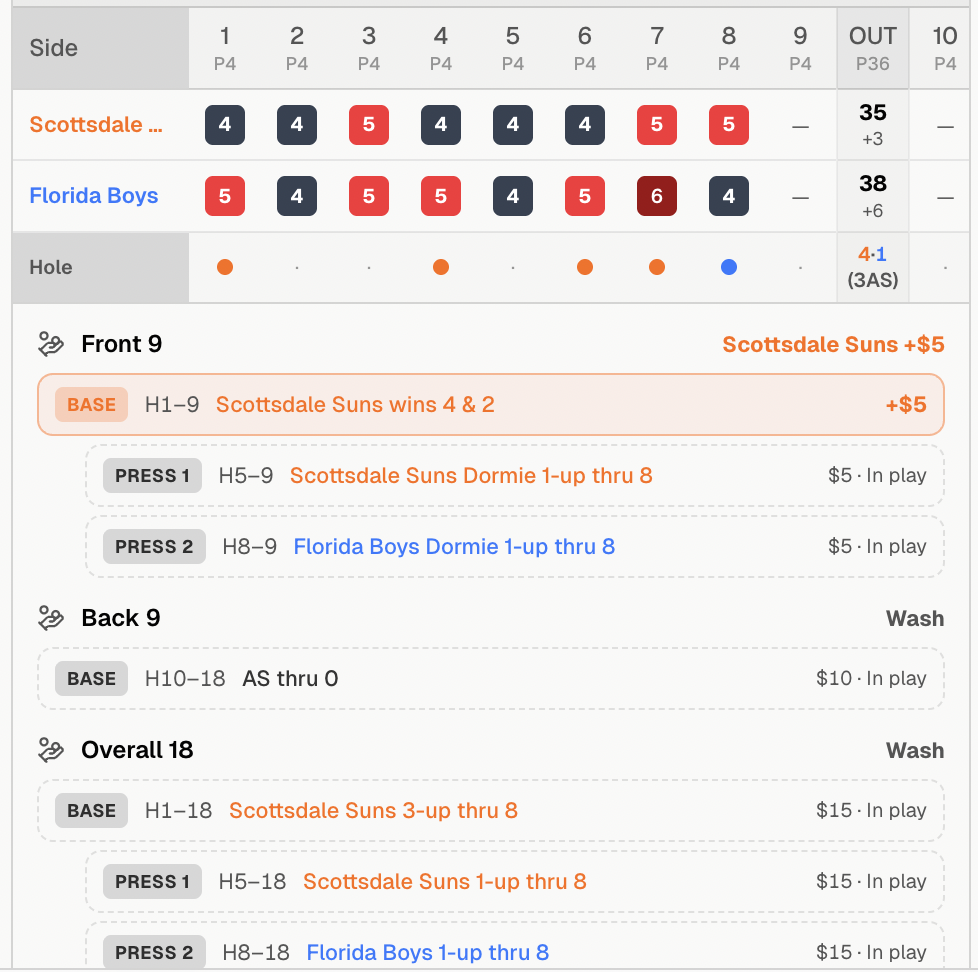
So, you've gone 2-down after hole 6, you can press on the front 9. Now there's a base bet on the front 9 AND a separate press bet on holes 7-9, creating a three-hole match. Each press starts at all square (AS).
The base bet and the press operate independently. You can win the press and still lose the base, or vice versa. Each settles on its own outcome at the end of its respective match.
Presses cascade. This is where it can get especially fun. If a press bet itself goes 2-down, the trailing side can press the press. A side that's getting buried has nested layers of opportunity to recover (or dig deeper depending on your world view).
A few important rules:
- Press value. The value/amount risked in a press is equal to the amount of its corresponding match. If the front 9 match is $5, every front 9 press is $5.
- Closed matches cannot be pressed. Once a match is mathematically over (3 & 2, 4 & 3, etc.), no more presses on that match are allowed.
- One press per match per trigger — you don't get to re-press when the deficit oscillates. If you went 2-down and pressed, then climbed back to 1-down, you can't re-trigger another press just because you went 2-down again.
- Tied presses always wash. A press that ends all square (after hole 9 or 18) pays nothing.
Press triggers can be configured: ForeBoard supports auto-trigger at 2-down (the press fires automatically when the deficit hits) or manual trigger (the trailing side taps a button to press, giving them the option to decline). Manual is the traditional and more cautious approach. Auto is faster, ensures the most action, and prevents the "wait, did anyone press?" discussion that tends to happen on the back nine.
If you're new to Nassau, it could be wise to play a game or two without stakes (ForeBoard has this option) and the press auto triggered. You will quickly understand how presses work, and why this game is so popular, without worrying about your wallet. You will quickly pick it up though, and can then take the training wheels off and start playing for stakes.
The Vegas press — optional one-hole drama
ForeBoard supports an optional layer called the Vegas press.
If the front-9 base match is 1-down entering hole 9, the trailing side can fire a one-hole press for hole 9 only — a single-hole side bet at the same stake. Same rule applies to the back-9 base entering hole 18.
The Vegas press resolves in one hole. Win the hole, you collect. Lose the hole, you pay. Tied hole washes.
A guy 1-down going into 9 can either ride the loss/potential push or fire the Vegas press and try to steal a win.
Singles vs Best Ball Nassau
ForeBoard supports two competition modes — pick at round creation.
Singles Nassau is 1-on-1. This is the traditional format and what most "Nassau" references mean by default. Just you and your buddy.
Best Ball Nassau is 2-on-2. Each side's lowest ball counts on every hole. The standard Nassau rules apply at the team level — the three separate match play matches, presses when 2-down, the works. Best ball Nassau is the natural mode for trips, member-guests, and any time you want the format to forgive a player having a rough hole.
Net or gross scoring works for either mode. Net scoring is almost recommended assuming your group is tracking handicaps. If it is not, you should start now. It'll make golf, and all available side games, more appealing because it makes them more competitive.
ForeBoard pulls course data and applies handicap strokes automatically — no arguing about which hole Bob pops on.
The math problem
Here's what falls apart on a paper scorecard.
By hole 7, your group has four concurrent matches running. Front 9 is at 1-down. You're a push on hole 8 from the Vegas push coming into play. There's already been one front 9 press. And the overall 18 is also at 1-down (since it tracks cumulatively). Each of these has its own status that updates every hole.
By hole 12, the front 9 is over (the front 9 base and all front 9 presses settled). The back 9 base is in progress. The overall 18 is also running. Somebody went 2-down on the back and pressed — now there's a back base, a back press, and the overall 18 all running concurrently.
By hole 17, somebody's claiming the press on the back was actually triggered at hole 13, not 12. Nobody can read the number written down on hole 15. The math guy is doing arithmetic with an eraser-less broken pencil. And the entire group is waiting at the 18th tee, unsure where the money stands.
This is the universal Nassau experience. The per-hole rules are simple. Tracking 3 different base matches plus presses plus possible carry-overs is what few group have the bandwidth for.
ForeBoard runs the entire machine automatically. Enter your hole scores, ForeBoard updates all three base matches, fires presses when 2-down (if auto trigger is on) or surfaces the press button (if manual is on), tracks every cascade, tracks Vegas presses, and runs the running money tally. The leaderboard shows each match's status in real time on every player's phone. You hit the ball and type a number. ForeBoard handles the rest.
Carry-over options
Nassau groups handle tied base matches (front, back, overall) differently. ForeBoard supports three modes — pick one at round creation.
This only applies to base matches. All presses wash if tied after hole 9 or 18.
None. Tied base matches wash. No money changes hands.
Carry forward. A tied front 9 rolls its stake into the back 9 (the back 9 stake is now the original back stake plus the rolled-over front stake). A tied back 9 rolls into the overall 18. A tied overall 18 washes — there's nowhere to carry it.
Double-or-nothing. A tied front 9 doubles the back 9 stake instead of rolling. Same for the back 9 doubling the overall. A tied overall 18 washes.
Carry forward is the most common variant; double-or-nothing can amplify the stakes. None is the least dramatic.
Lock this rule before the first tee so you're not having to decide on the 9th fairway with push starting you in the face.
House rules worth locking down before the first tee
A few more decisions that need to happen at the parking lot:
- Press cap per leg. ForeBoard supports unlimited presses but some prefer to limit the number (2 or 3 is typical).
- Vegas press on or off. Default off. Turn on for groups that want maximum drama.
- Overall 18 base pressable. ForeBoard supports an optional press on the overall 18 base bet (but it must be made while playing the front 9).
- Gross vs net. Default to net in any mixed-handicap group. Gross is fine. Again, use net scoring if everyone has handicaps. It's better.
- Stakes amount. Lock before the first tee. You'd think this is common sense. You'd be wrong.
The five-text exchange in the group chat the night before or morning of ensures a smooth round.
When Nassau works best
The format shines in specific conditions:
- Twosomes or foursomes — Nassau is built for 1v1 or 2v2. It doesn't translate to threesomes or fivesomes without significant rewrites.
- Mixed-handicap groups, with net scoring. The three-match structure means a weaker player can win the front 9, lose the back 9, and tie the overall — still a competitive round. Net keeps the round alive.
- Groups that like back-and-forth drama. Presses provide huge momentum swings. If your group enjoys chirping, Nassau gives you plenty to talk about.
It works less well for:
- Groups that hate variance. Press cascades can compound stakes quickly.
- Groups that can't agree on rules. Carry-over modes + press caps + Vegas press toggle = a lot of variables. Lock them all down before the round.
The trip translation
For buddies trips and those running Ryder Cup–style scoring, Nassau converts cleanly: each matchup is worth one Ryder Cup point, awarded to the side ahead on money (or matches won if stakes are off).
This is why Nassau slots so well into a Ryder Cup trip rotation. Day one is Best Ball. Day two can be Best Ball Nassau (which has more in-day drama than a single match-play round). Or day three could be Singles Nassau.
Imagine the whole trip coming down to a Vegas press on the final hole of the weekend…
Ready to try Nassau? Create a round on ForeBoard → Pick your players, choose Nassau as your format, decide singles or best ball, set your stakes (or skip them), and pick your carry-over treatment. Share the link with the group. ForeBoard runs the three matches, every press, every cascade, and the final settlement automatically. You're scoring within thirty seconds — no app, no accounts, no math arguments at the bar.