It's mid-November. You're sitting at your desk looking at the calendar, mostly green-blocked with corporate outings, charity scrambles, and a couple of member-guests at the private clubs you also manage. Three weeks from now is the Christmas Scramble — the public event your course has run every December for the last eight years.
The format hasn't changed. Same playbook every year. Players sign up online or call the pro shop, you pre-build foursomes, day-of you hand out scorecards, beverages, and tee gifts. Players write their team scores on paper. They drop the cards at the clubhouse on the way to lunch. Your assistant tallies them in a spreadsheet while pouring drinks. The leaderboard goes on a whiteboard sometime around 1pm. Most players have already gone home.
Eighty players. $500 a foursome. Twenty foursomes is $10,000 of revenue. And the scoring experience is roughly what it was in 2014.
If you're a tournament manager or head of sales at a public course, this is the post. You spend most of your time selling outings to corporate groups, charity organizers, and member-guest hosts. But three or four times a year you run your own event — a Christmas scramble, a summer glow-ball night, a Memorial Day opener, a large-cup novelty day. They fill the calendar between paid bookings, they build the customer database for next year, and they generate the marketing content that sells future packages.
The premise: these events deserve more attention than they get, because they're the most visible thing your course does to the general public. And the scoring layer is where most courses are quietly leaving professionalism on the table.
Why the public events matter more than the calendar implies
The math is straightforward but worth saying out loud.
Your tournament sales pipeline runs on three legs: corporate outings (your highest-margin work), charity events (your relationship layer with the local nonprofit community), and member-guest tournaments at private clubs you also host. Public events look like a different category — lower individual ticket, walk-in players, less commercial focus.
But the public events do work the rest of the pipeline can't do on its own.
They fill the calendar on days you couldn't have sold to a corporate buyer. A Saturday in mid-December isn't a corporate sales day — but it can be a $10,000 public-revenue day if you run a Christmas scramble. That's pure incremental revenue on a day that otherwise sits as standard tee times.
They build a customer database for outbound sales. Every player who registers for your Christmas scramble is now in your database — name, email, willingness to spend $125 on a four-hour event. That's a high-quality lead for your tournament sales team's outbound work next year. Six months later when their company is planning a sales kickoff, your email is the one that arrives.
They generate marketing content. Photos of eighty players smiling on the first tee on a December morning, leaderboards from a fun summer event, costume photos from a Halloween scramble — this is the content that goes on your Instagram, your website hero, your outbound email templates. It says "this is a place where things happen" better than any sales deck can.
They differentiate you locally. Public courses are competitive — the player choosing between three options in the area is choosing partly on event programming. The course that runs four memorable public events a year is the one that gets the repeat play.
Which means: treating these events as throwaway is a real revenue mistake. Each one is a marketing investment that should pay back across the year.
A short menu of events that fit a public course's calendar
The proven set, by season:
Christmas Scramble (early-to-mid December). The classic. Holiday gift exchange optional, tee gift mandatory, lunch with hot cocoa stations. The event fills a calendar day where the corporate buyers aren't booking and the weather is cold but typically playable. Costume elements optional — some courses lean in, others keep it simple.
Halloween / Pumpkin Scramble (late October). Costume-encouraged scrambles work surprisingly well in mild-weather regions. Pumpkin tees, candy in the gift bag, a costume contest at lunch. Easier sell to families and couples than a traditional event.
Couples' / Valentine's Scramble (mid-February). Two-couple scrambles with date-night framing. Smaller turnout than the December event but high engagement and great for social content. Works in warmer regions; some northern courses skip this one.
Memorial Day / Independence Day Openers (late May / early July). Patriotic-themed events with American flag pin contests, red-white-and-blue tee gifts. Strong turnout, generally easy to sell because it lines up with three-day weekend plans.
Summer Glow-Ball / Night Scramble (June through August). Nine-hole glow-ball events run as the sun sets. Specialty equipment (glow balls, glow sticks for the cups) but a memorable experience worth the small upfront cost. Often the best photo content of the year.
Large-Cup / Champagne-Pin Novelty Days. The course swaps in oversized cups for the day. Comically easy putting, comedy scoring. Works as an end-of-summer or shoulder-season event when you want something fun and low-stakes.
Most courses pick three or four of these for the year and run them annually. Consistency builds recognition — local players know "the Christmas scramble at [course]" is happening every December and plan around it.
Pricing and the foursome-first sales motion
A few pricing realities for a public-event customer:
The price has to include enough that it feels like an experience, not a tee time with extras. The standard structure is $300 to $600 per foursome ($75 to $150 per player) — covering greens fees, carts, range balls, a tee gift, lunch, and contest entries. Below $75 per player, the event feels like a regular tee time and players don't get the "tournament" perception. Above $150 per player, you need real prize structures to justify it.
Sell foursomes, not individuals. Two reasons. First, foursomes self-organize — you don't have to build pairings on the morning of. Second, the foursome buyer is usually one person paying for three friends, which means they're a higher-LTV customer for your tournament sales team. The person willing to drop $500 to organize their golf group for Saturday is the person whose company might book a corporate outing in the spring.
Open registration four to six weeks out. The Christmas Scramble that goes on sale in mid-October is the one that fills. The one that goes on sale December 1 is the one that's half-empty.
Use a free registration platform. Eventbrite, Givebutter, or a basic landing page with a Stripe link. Most courses don't need anything more sophisticated for four events a year. The paid event-management platforms are built for higher-frequency operators.
Format selection — keep it forgiving
Public events draw a wide range of skill levels. Your foursome buyer is paying for a fun afternoon, not a competition that ends with their group six shots out of last place after the third hole.
Default to scramble for every public event. Every player tees off, the team plays the best ball, repeat. The format is forgiving for low-skill players (their bad shots get covered up by the team), keeps pace at four hours, and lets a four-handicapper play with two twenty-handicappers without anyone feeling like they ruined it.
If your audience leans more competitive — say, an event marketed to regulars and serious local players — shamble is the natural step up. Drives are scrambled (everyone hits, team picks the best drive), then everyone plays their own ball into the cup. Slightly harder than scramble, more competitive, still forgiving enough for mixed skill.
Avoid stroke play, match play, and net-scoring formats for public events. Most public players don't have an established handicap, so net scoring is a non-starter. Stroke and match play punish weaker players and grind pace. Save those formats for the corporate and member events your day job actually sells.
Gross scoring is fine for public events. The format already equalizes through the scramble mechanic. Skip the handicap step.
Day-of operations — short program, long lunch
Run the day clean and simple.
Arrive at the course by 6:30. Course operations team handles cart staging, range balls, and signage placement. Your one event ops staffer owns the registration table and the contest markers. You — the tournament manager — work the front of house and the clubhouse.
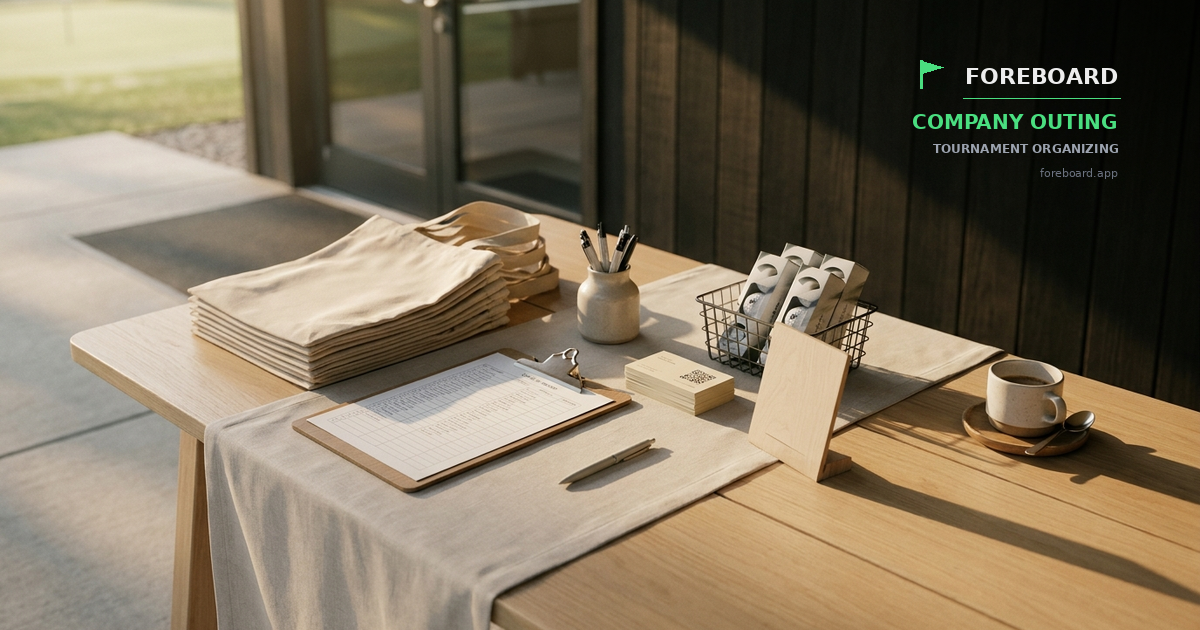
Doors open by 7:30. Players check in at registration, receive tee gifts, get their cart and starting hole. Range opens. Coffee and breakfast snacks available.
Brief tee announcement at 8:25. Welcome players, name the contests, mention lunch time. Two minutes. Send them off.
Shotgun start at 8:30. Round runs four hours. You're in the clubhouse handling logistics — making sure lunch is on time, the beverage cart is running, and your sales team has whatever they need for follow-up customer conversations later. Take photos. Walk the course if pace allows.
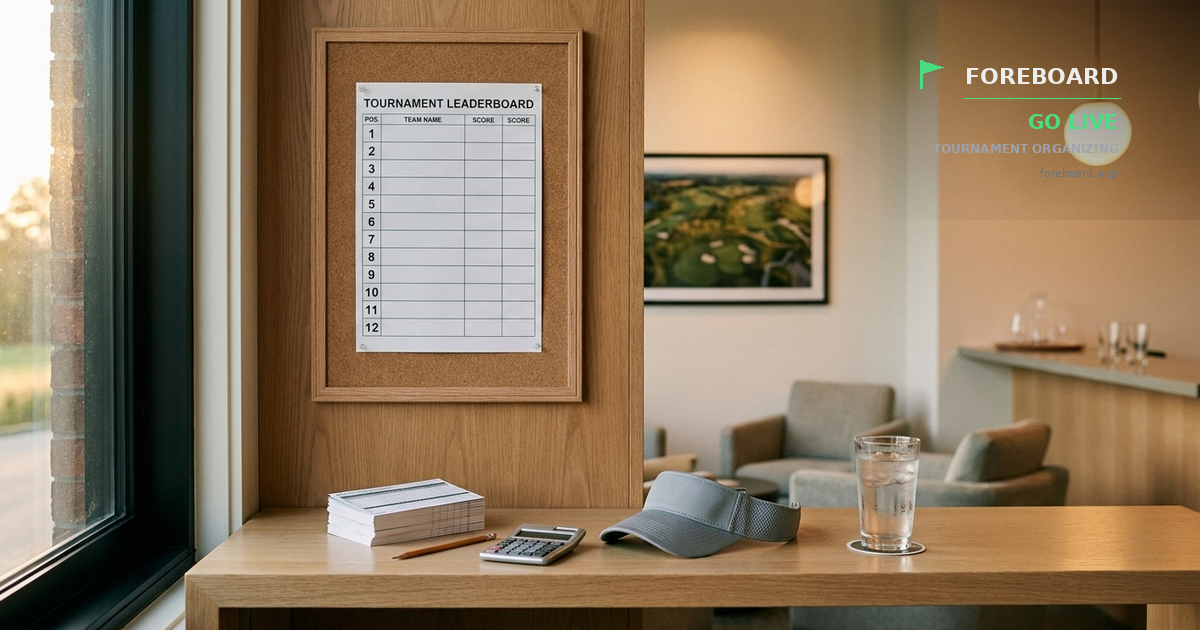
Lunch starts at 12:30 as the first groups come in. The leaderboard is the centerpiece. Players who finish early can see how they stand and watch as later groups post scores. This is the social moment of the event — it should feel like a party, not a debriefing.
Brief program at 1:30. Thirty minutes max. Welcome and thanks, contest winners (closest to pin per par 3, longest drive on a designated par 5, optional costume contest), team standings (gross and net or just gross if it's a public event), save-the-date for next year. End with prize handouts and let players linger.
Most public players head out by 2:30. Your team closes the loop on sponsorship follow-ups, photo collection, and event notes.
The scoring problem
Here's the part most courses haven't updated in a decade.
For your corporate and charity tournament work, the buyer often brings their own software preference — GolfGenius, BlueGolf, Tourney Machine, Golf Tournament Organizer. These are professional-grade tools built for clubs running thirty-plus events a year, complex flighting, multi-round formats, USGA handicap integration. They're priced accordingly — $300 to $1,500+ per event, sometimes with annual contracts that run $5,000 to $15,000.
For events run at that frequency and complexity, the software earns its keep.
For your public events, the math falls apart. You run four of them a year. Christmas, Memorial Day, summer glow-ball, fall pumpkin event. Even at the lower end of the per-event pricing, that's $1,200 to $6,000 of software cost for events that already operate on tighter margins than your corporate work. Most courses look at that number, decide the cost-benefit doesn't work, and fall back to what they've always done: scorecards on paper, captains writing team scores down, dropping the cards at the clubhouse, your staffer tallying them in Excel between pouring drinks.
The manual approach works. Eighty players, twenty foursomes, an hour of tallying. The leaderboard gets posted around 1pm on a whiteboard. Players who finished early are mostly gone by then. The scoring drama — the back-nine arc, the "who's leading at the turn" moment, the lunch leaderboard reveal — never gets to happen because there is no live leaderboard. Players experience a flat scoring moment instead of an arc.
It also doesn't scale gracefully. Eighty players is manageable. A hundred and twenty starts to break. And as your events grow (which is the goal), the manual scoring becomes the bottleneck on the experience.
There's a middle option that's appeared in the last few years: free live-leaderboard tools built specifically for events that don't justify paid tournament software but still deserve real scoring. ForeBoard is one — designed for exactly this gap. Live leaderboards on every player's phone, scores entered by team captains (your staff stays out of it), a clubhouse spectator link you can put on the TV during lunch, and final results emailed automatically to every player the moment the round ends. Free per event. No per-player fee. No annual contract. (If that raises the obvious question — what's the catch? — here's the honest answer.)
How it lands in the public-event operating rhythm:
- Setup, 2 minutes. Create the event, name the format (Scramble), enter the teams. Share one join link with your foursome captains in the pre-event email.
- Day of. Captains tap the link on their phone — no app, no account, no friction. They enter their team's score on each hole. Leaderboard updates live on every player's phone and on any spectator screen you point at it.
- Lunch. The leaderboard is on the clubhouse TV. Players watching from the bar, photographing it for their feeds. The scoring drama happens during the meal, not after most players have gone home.
- After. Email final results to every player with a save-the-date for next year. Done.
The cost difference matters because the math is different from corporate tournament software. You aren't replacing your buyer's preferred platform. You're upgrading the scoring layer on the events you run yourself, where you control the spend. The savings ($1,200 to $6,000 annually on software you'd use four times) goes straight back to your event budget — better tee gifts, better food, better prizes, all of which raise your repeat rate.
Post-event work — the marketing flywheel
The closeout is where the public events do their highest-leverage work for the rest of your business.
Within 24 hours. Email final standings and a few action photos to every player. Include a brief "join us next year" line and a soft CTA — "looking to host a corporate event at the course? Reply and we'll send a package" — that converts the public-event customer into a tournament sales lead.
Within 72 hours. Post the event recap on social media. Tag local sponsors. The leaderboard screenshot from ForeBoard or your scoring platform makes a clean visual asset for these posts.
Within two weeks. Add every registered player to your tournament sales nurture sequence. Your sales team's spring outbound work just got eighty new contacts who already trust your course.
Within a month. Internal recap. What worked, what didn't, what to change next year. Save the registration list — it's the seed list for next year's marketing.
Every quarter. Revisit the public-event calendar. Are you running the right mix? Are the events growing year-over-year, holding flat, or shrinking? Public events that shrink usually do so quietly — turnout drops 10% a year and three years later you've lost a third of the audience without realizing it.
The events that grow are the ones that get treated like real product launches. The events that shrink are the ones that get treated like calendar fillers.
When the math says do this, when it says don't
A few sanity-check questions before adding a new public event to your calendar:
- Can you reach 60 to 80 paying players in your local market? If not, the economics get tight fast.
- Is the date a calendar day you couldn't have sold to a corporate buyer? If yes, it's incremental revenue. If no, you're potentially cannibalizing higher-margin work.
- Does the event fit a recognizable hook — holiday, season, novelty — that members of the public can immediately understand? Generic "scramble at the course" struggles to fill seats.
- Do you have the staff bandwidth for it? Running four public events a year on top of forty corporate bookings is feasible. Running ten public events plus the corporate work isn't.
Pick the three or four that fit cleanly. Run them annually. Treat them like real products. The scoring layer is one of the easier improvements available and the one that disproportionately changes the player perception.
Running a public event at your course? Set up a free tournament on ForeBoard → Two minutes to set up. Captains score on their phones. Live leaderboard on the clubhouse TV during lunch. Final results emailed automatically. No app, no accounts, no per-event fee. Try one Saturday — if it doesn't change how the event lands with your players, you can go back to clipboards next time.